

The export finished cleanly. The PDF looked fine in the preview. Then the Google Doc opened and the tables were sitting on top of the images, text was bleeding past the margins, and the lesson that took thirty minutes to build inside Diffit looked like it had been through a document shredder.
The instinct is to blame the tool. That instinct is wrong — and acting on it costs more time than the original formatting problem ever did.
Teachers and course creators who export Diffit-generated materials to Google Docs for editing or distribution
You need pixel-perfect print layout — Pageless Mode trades print precision for stable screen formatting
Formatting collapse → manual rebuild: roughly 40–60 minutes. Container fix applied correctly: under 5 minutes
The content is fine. The container is broken. Fix the container first before touching a single table cell.
The Wrong Diagnosis That Makes Everything Worse
When a Diffit export lands in Google Docs with overlapping tables and shifted images, the natural first move is to start dragging elements back into position manually. Resize this column. Delete that image anchor. Nudge the table left. Twenty minutes later, the layout is still broken — just differently broken.
The wrong diagnosis here is assuming Diffit produced a corrupted file. The actual cause is simpler and more fixable: Diffit’s export is built around a content structure that assumes a certain container width, and Google Docs’ default page setup does not match it.
Google Docs defaults to a standard US Letter page with 1-inch margins on all sides. That gives you a usable content width of roughly 6.5 inches. Diffit’s internal layout — especially for reading passages with embedded tables, vocabulary grids, and comprehension question blocks — is structured for a wider or margin-free container. When those two widths collide, the content doesn’t compress gracefully. It overlaps. Teacher workload spikes immediately because the visible failure looks like a content problem when it’s a container problem.
Fixing individual elements without fixing the container is like adjusting furniture in a room with the wrong floor plan. The room is the problem, not the furniture.
The Chain Reaction Nobody Expects
Here is where the cascade becomes expensive. A teacher exports a Diffit reading activity, sees the broken layout, and starts reformatting manually. That manual edit takes the document off the clean Diffit structure — so re-exporting later won’t help. The document is now a hybrid: part Diffit output, part hand-patched formatting. Every future edit carries the weight of that patch.
The lesson planning burden doubles. Not because the AI tool failed, but because one container mismatch triggered a chain of manual corrections that compounded.
The fix has to happen before any manual editing starts. Applying it after the fact is possible, but the cleanup is messier.
Workflow Comparison
❌ Wrong Path
Export → see broken layout → drag tables manually → resize columns → 45 minutes lost → layout still unstable → re-export fails because document is now a hybrid
✓ Operator Path
Export → fix container first (Pageless Mode or margin adjustment) → content settles into correct layout → edit content only → clean document maintained
The Container Fix: Pageless Mode First
Google Docs introduced Pageless Mode as a formatting option that removes the concept of page breaks and physical page boundaries entirely. For Diffit exports specifically, this is the fastest resolution for overlapping tables and image collisions.
To switch: open the Google Doc → File → Page setup → Pageless. Apply it to the document. The content width expands to fill the viewing window, and Diffit’s structural layout — which assumed a wider or flexible container — stops fighting against a fixed page boundary.
In most cases, tables realign, images stop overlapping adjacent content blocks, and the vocabulary and comprehension sections return to a readable structure. The fix takes under two minutes. The layout shift is immediate.
One tradeoff: Pageless Mode removes print pagination. If the lesson needs to be printed for students, this matters. But for a Google Classroom assignment, a shared link, or an LMS embed, Pageless Mode is the cleaner default for Diffit content.
When Pageless Mode Isn’t Enough: Margin and Font Scaling
Switching to Pageless Mode resolves most overlap issues. But on some exports — particularly those with dense multi-column vocabulary tables or side-by-side question formats — the content still crowds the edges or runs text into adjacent cells.
The secondary fix is margin adjustment on the standard page layout. If Pageless Mode isn’t appropriate for the use case (print distribution, for example), go to File → Page setup → Pages and reduce the left and right margins from the default 1 inch to 0.5 inches. This widens the content area by a full inch and gives Diffit’s table structures enough room to render without collision.
The third lever is font scaling. Diffit exports sometimes carry a base font size that, when rendered inside a narrower Google Docs container, causes text to wrap in ways that push table rows out of alignment. Selecting all text (Ctrl+A) and reducing the font size by 1–2 points — from 11pt to 10pt, for example — can resolve row-height stacking that pushes images out of position.
Apply these in order: Pageless Mode first. Margin reduction second. Font scaling third. Each step is reversible. None of them require touching the actual lesson content.
What the Broken Layout Is Actually Costing
What This Actually Replaces
Fixing a broken Diffit export isn’t a formatting task — it’s recovering time that disappeared between “the AI generated the lesson” and “the lesson was actually usable in class.” The invisible cost isn’t the broken table. It’s every manual edit made before anyone realized the container was the problem.
A single overlooked container mismatch typically triggers roughly 40–60 minutes of manual reformatting. Applied across a week of lesson planning, that’s not a minor inconvenience — it’s a recurring tax on the entire AI-assisted workflow. The AI tool did its job. The environment swallowed the output.
Where This Fix Does Not Help
The container fix works when the formatting problem is caused by a page width mismatch. It does not solve every Diffit export issue.
If the exported PDF itself is corrupted before it reaches Google Docs, switching to Pageless Mode will not recover missing content. The upstream export is the problem in that case, and the fix is re-exporting from Diffit rather than adjusting the Google Doc settings.
Similarly, if the Diffit content includes complex nested tables — tables within tables — Pageless Mode may reduce but not eliminate overlap. Google Docs has known rendering limitations with nested table structures regardless of page settings. In those cases, manually splitting the nested table into sequential single-level tables is the more reliable path, even though it adds time.
Font substitution issues — where the exported document displays a different font than what Diffit used internally — are also not resolved by container fixes. That’s a font-embedding issue in the PDF-to-Docs conversion pipeline, and it requires either accepting the substituted font or manually reapplying the preferred typeface after import.
The container fix is a reliable first response, not a universal solution. Knowing where it stops working prevents a second round of misdiagnosis.
The Practical Scenario: Before and After
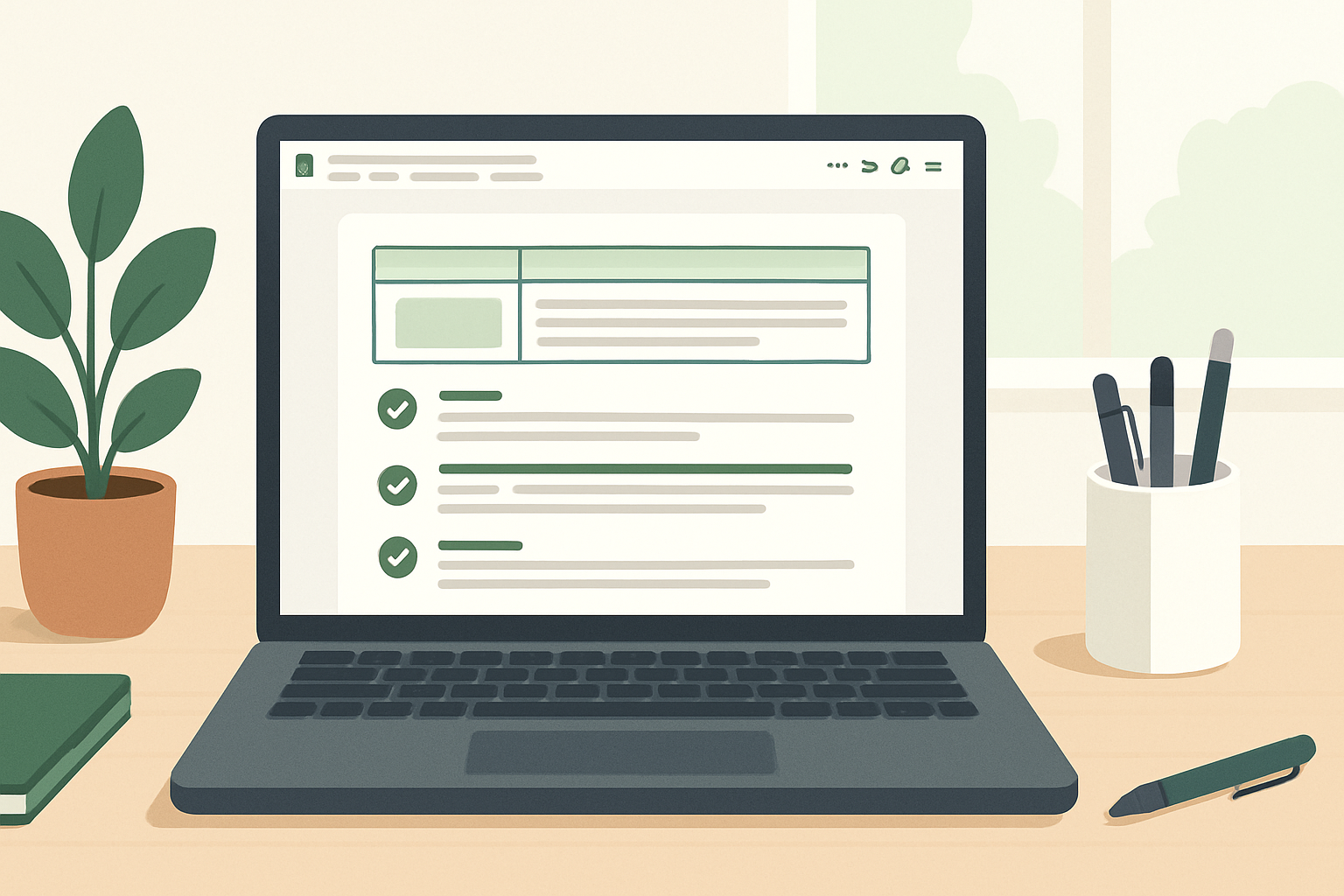
A reading activity exported from Diffit — a two-column vocabulary table, a passage block, and eight comprehension questions — lands in Google Docs. The vocabulary table is sitting halfway over the passage text. Two of the comprehension questions are pushed below the visible area of the page. The layout looks unusable.
Before the fix: Attempt to drag the vocabulary table back into position. The table moves but the passage block doesn’t follow. The comprehension questions shift further. After 35 minutes, the document is manually restructured but no longer matches the original Diffit format — which means sharing a template version with colleagues is now complicated.
After the fix: Close the document without editing. Reopen. Go to File → Page setup → Pageless. Apply. The vocabulary table drops into its correct position beside the passage. The comprehension questions return to sequential order below the passage block. Total time: under three minutes. The document is clean, shareable, and still structurally aligned with the original Diffit output.
The content didn’t change. The container changed. That’s the entire pattern.
Education Value at a Glance
Free Resource: AI Lesson Workflow Notes
If you’re building a repeatable workflow around Diffit and Google Docs, the formatting fix is one piece. The larger pattern — how to structure AI-generated materials so they stay editable across tools — is worth documenting once and reusing every time. Our AI lesson workflow notes cover the container-first approach for Diffit, Canva, and Google Slides exports. Available free at AI EdTech Review.
Course Creator Note
Every AI-generated lesson lives inside a container it didn’t choose — and when that container is wrong, the lesson fails before a single student sees it. This is the broader pattern across every AI content tool: the output quality is only as stable as the environment receiving it. The lesson isn’t broken. The room it was put in is.